
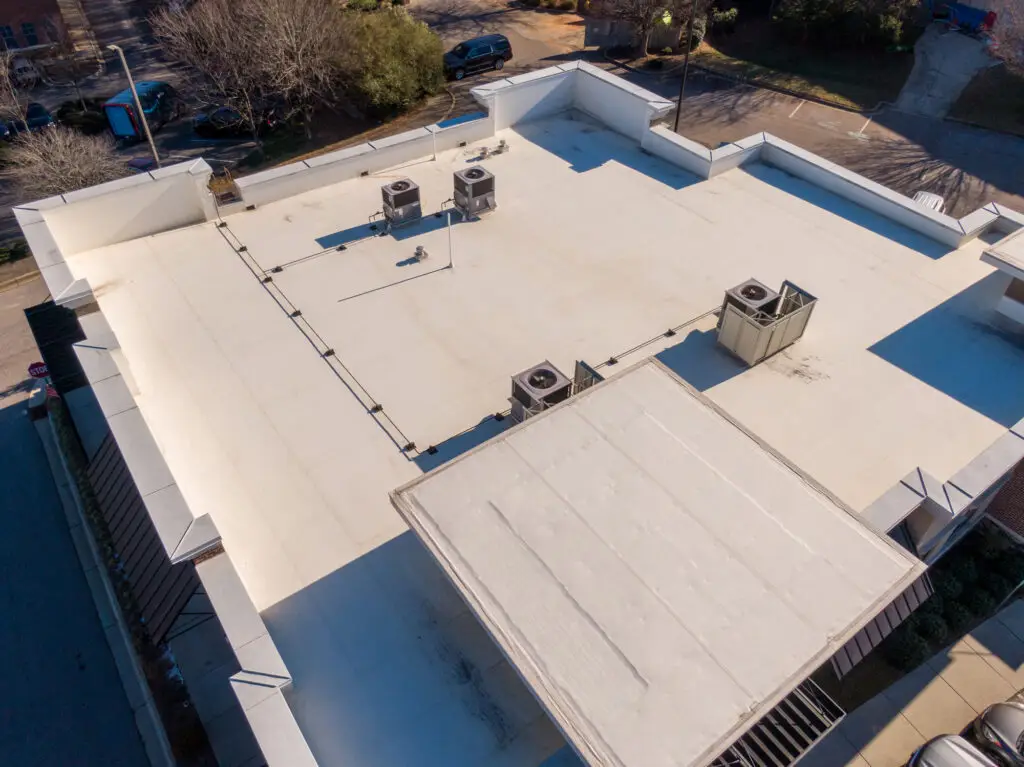
Metro Atlanta has no shortage of roofing companies. That is the problem.
Georgia does not require a state roofing license, the barrier to entry is low, and the market churns constantly — companies form, chase a few seasons of work, and dissolve. Meanwhile the roof you are about to buy is expected to last 20 to 30 years and represents one of the largest capital expenditures your property will see this decade.
The gap between those two facts is where building owners get hurt.
This guide covers what actually goes wrong with commercial roofs in Georgia’s climate, what to verify before you sign anything, and how to compare proposals that are deliberately structured to be hard to compare.
What Actually Kills a Flat Roof in Atlanta
If you have read roofing content written for the Midwest, you have read a lot about hail. Atlanta gets hail, but it is not the main event here. Our climate attacks low-slope roofs differently, and understanding how changes what you should be asking contractors.
Heat and UV. Atlanta runs above 95°F for extended stretches, and a dark membrane on a flat roof gets far hotter than the ambient air. Sustained thermal cycling breaks down membranes, hardens sealants, and works fasteners loose over time. It is slow, invisible from the ground, and it is the reason roofs here rarely fail dramatically — they degrade.
Ponding water. Georgia’s humidity and heavy summer downpours mean standing water finds every low spot. Most commercial roof systems are designed to shed water, not hold it. Water that sits for more than 48 hours accelerates membrane breakdown, stresses seams, and grows biological material that holds even more moisture. Drainage design and slope correction matter more here than most contractors admit in a bid.
Humidity and trapped moisture. This is the expensive one. When moisture penetrates a seam or flashing and gets into the insulation, the roof keeps looking fine from above for years while the R-value collapses and the deck corrodes underneath. By the time it shows up as a ceiling stain, you are often past the point where a repair solves it.
Storm and wind events. Spring and summer thunderstorms bring high winds and tropical moisture pushing up from the Gulf. Edge metal and flashing details — not the field of the roof — are where wind damage starts.
The practical takeaway: in Atlanta, the details and the drainage are the job. A contractor who talks only about membrane brand and price is telling you what they do not know.
Georgia Licensing: What to Actually Verify
Georgia does not issue a state roofing license. There is no registry you can search the way Kansas or Florida property owners can, which puts more of the verification burden on you.
What does apply: commercial construction work in Georgia generally falls under the Georgia State Licensing Board for Residential and General Contractors, with a General Contractor license or a Residential-Light Commercial license required depending on the scope and size of the structure — and licensing thresholds start at jobs over $2,500. Many municipalities also require a local business license before a contractor can pull permits, pass inspections, or bid public work.
Separately, the Georgia Roofing Contractors Association runs a voluntary certification program. It is not required, and its absence does not disqualify anyone — but its presence is a signal that a company invests in credentials it did not have to earn.
What to ask: “What is your Georgia contractor license number, and which counties and municipalities are you licensed to pull commercial permits in?” Then verify it, rather than accepting the number on faith.
The Verification Checklist
Beyond licensing, five things separate contractors who will stand behind the work from contractors who intend to.
Insurance certificates sent directly from the carrier
General liability and workers’ compensation, current, with limits appropriate to your project value, and ideally naming your entity as an additional insured. Ask for it to come straight from the insurance agency rather than from the contractor. Certificates that pass through an intermediary can be edited; ones that do not, cannot.
Workers’ comp is the one people skip. If an uninsured worker is hurt on your roof, the exposure can land on the property.
Manufacturer certification for the system being proposed
The strongest commercial roof warranties are manufacturer NDL — No Dollar Limit — warranties covering both material and labor. Manufacturers issue them only through certified installers, and they inspect the finished roof first.
If your contractor is not certified for the TPO, PVC, EPDM, or modified bitumen system in their proposal, that warranty tier is unavailable regardless of what the contract promises. You would be relying on a contractor-backed workmanship warranty instead — which is worth precisely as much as the contractor’s longevity.
What to ask: “Which manufacturers are you certified with, and what warranty can you actually get issued on this building?”
A moisture survey before anyone quotes a replacement
This is the Atlanta-specific one, and it is the question that most reliably separates serious contractors from the rest.
Because trapped moisture is invisible from the surface, a contractor who bids your roof from a walkthrough alone is guessing at the most important variable. Core cuts, infrared scanning, or a capacitance meter tell you whether the insulation is wet — which determines whether you need a full tear-off, a partial replacement, or whether a coating or restoration is even an option.
A contractor who skips this step and goes straight to a replacement number is either not thorough or not interested in the cheaper answer.
What to ask: “How will you determine whether the insulation is wet before you quote this?”
Commercial references from the past twelve months
Not residential. Low-slope commercial roofing is a different trade from shingle work — different systems, different detailing, different failure modes — and plenty of Atlanta companies are strong residential roofers with thin commercial experience.
Ask for three commercial properties completed within the last year, comparable in size and system to yours. Call one. Ask what went wrong and how it was handled, because something always goes wrong and the handling is the actual information.
The warranty document itself, before you sign
“Twenty-year warranty” is not a specification. Read the document and find out:
- Who backs it — manufacturer, contractor, or both
- Whether it covers material only, or material and labor
- What voids it — foot traffic, HVAC technicians servicing rooftop units, new penetrations, and skipped maintenance all void coverage under some warranties
- What is required of you to keep it in force, which is often documented annual or semi-annual inspections
Our commercial roof warranty guide breaks down the language that tends to surprise people.
Why the Cheapest Bid Is Usually Missing Something
Three proposals on the same Atlanta building can differ by 40% and all be honest — because they are not describing the same work.
Before you compare prices, confirm each bid states the same:
Tear-off vs. overlay. Installing over an existing membrane is cheaper and occasionally appropriate. It also traps any existing moisture, shortens the new roof’s life, and building codes limit total layers. This is frequently the entire difference between the low bid and the middle bid.
Insulation and R-value. Georgia energy code may require more insulation than what is currently up there. Insulation is a genuine cost line, and a bid that reuses existing insulation is not comparable to one that replaces it.
Drainage and slope correction. If your roof ponds, a new membrane over the same slope will pond too. Tapered insulation, additional drains, or crickets add cost — and a bid that ignores ponding is quietly deferring the problem to you.
Deck repair allowance. Nobody knows what is under the membrane until it is off. A bid with no stated allowance for deteriorated decking is not cheaper; it is a change order you have not received yet.
Flashings, edge metal, and penetration details. Where Atlanta roofs actually leak. Also where cheap bids economize.
Warranty tier. A 10-year contractor warranty and a 20-year manufacturer NDL warranty are different products at different prices.
Once the scopes match, compare the numbers. The gap usually narrows sharply — and sometimes the low bid turns out to be the expensive one. For current benchmarks, see our Atlanta commercial roof replacement cost guide.
If You Manage Property for Someone Else
Property managers and HOA boards carry a different risk: you are recommending a contractor to an owner or a board, and you will be answering for that recommendation.
Four things protect you.
Put the scope in writing before soliciting bids. If you define tear-off, insulation, drainage, and warranty tier up front, every bid you receive is comparable by construction, and no contractor gets to win on an omission.
Require certificates of insurance naming the ownership entity as additional insured. Not the management company alone.
Get the warranty document into the file before award, not after. If a board later asks who backs the warranty, you want the answer in a folder.
Document the pre-existing condition. Photos and a written condition report before work begins settle nearly every dispute that comes up later.
Our post on five questions to ask before signing a roofing contract covers the contract-stage version of this.
Red Flags
- Door-to-door canvassing after a storm, particularly from a company with no local track record
- Pressure to sign immediately — “this price expires today” is a technique, not a constraint
- A large deposit before work begins — materials deposits are normal, half the contract value is not
- An offer to cover your deductible — this is generally insurance fraud and it exposes you
- A replacement quote with no moisture investigation — they are guessing
- No written scope — a number on a page is not a bid
- Evasiveness about licensing or insurance — legitimate contractors produce these instantly, because they are asked constantly
How American Commercial Roofing Measures Up
We would rather be judged against the checklist above than describe ourselves in adjectives.
We have been in commercial roofing for over three decades. We are licensed and insured, and we will have certificates sent directly from our carrier — you do not have to take our word for the coverage.
We install and service TPO, EPDM, PVC, built-up, modified bitumen, standing seam metal, and spray foam and coating systems. That range matters for a specific reason: a contractor who only installs one system will recommend that system. Because we work across all of them, the recommendation you get is driven by your building’s condition, drainage, and budget rather than by our inventory.
We assess moisture before quoting a replacement, because on Atlanta flat roofs that is the variable that determines whether you are looking at a coating, a partial, or a full tear-off — and those are very different numbers. If a restoration or coating is the right call for your building, we will say so.
Qualifying installations are backed by a $20,000 workmanship guarantee, and we walk you through the complete warranty document before you sign rather than after.
Inspections and estimates are free, and we do not run a high-pressure close.
Frequently Asked Questions
Do commercial roofing contractors need a license in Georgia?
Georgia does not issue a roofing-specific state license. Commercial work generally falls under the Georgia State Licensing Board for Residential and General Contractors — a General Contractor or Residential-Light Commercial license depending on the structure’s size and scope, with licensing thresholds beginning at jobs over $2,500. Many municipalities additionally require a local business license to pull permits. Ask for the license number and the jurisdictions the contractor is permitted in, then verify both.
How many bids should I get for a commercial roof in Atlanta?
Three is the practical standard. What matters more than the number is that all three bid the same defined scope — same tear-off decision, same insulation, same drainage work, same warranty tier. Otherwise you are comparing prices for different projects.
How long does a commercial roof last in Atlanta?
Most low-slope commercial systems are rated 20 to 30 years, but Georgia’s heat, UV exposure, and ponding tend to push real-world service life toward the lower end of the range when a roof is not maintained. Documented semi-annual inspections and prompt detail repairs are what close that gap — and they are often required to keep a manufacturer warranty in force.
Can I coat my flat roof instead of replacing it?
Sometimes, and when it is viable it costs substantially less. Coatings work on structurally sound roofs where the insulation is dry and the deck is intact. They do not fix a wet system — coating over trapped moisture seals the problem in. That is why the moisture survey comes before the recommendation.
What is the difference between a contractor warranty and a manufacturer warranty?
A contractor workmanship warranty is backed by the company that installed the roof and covers installation defects. A manufacturer NDL warranty is backed by the material manufacturer, covers both material and labor, and is only issued through certified installers after the manufacturer inspects the completed roof. The second is stronger, and it is the reason certification is worth asking about.
My roof only leaks in one spot. Do I need a full replacement?
Not necessarily. A single leak at a flashing or penetration is often a repair. The question is whether moisture has spread into the insulation beyond the visible point of entry, which is what a moisture scan determines. Our guide to flat roof repair vs. replacement covers how that decision is made.
Get a Real Assessment of Your Atlanta Roof
No article can tell you what your building needs. What we can do is get on the roof, check for moisture in the system, document the actual condition, and give you a written scope detailed enough to compare against anyone else’s proposal.
Free inspection. Detailed written estimate. No pressure.
Serving metro Atlanta and surrounding communities — see our Atlanta service area.
Get a Real Assessment of Your Atlanta Commercial Roof
Free inspection with a moisture check, a detailed written scope, and no high-pressure pitch.
Schedule Your Free Roof Assessment Call (800) 674-9535