
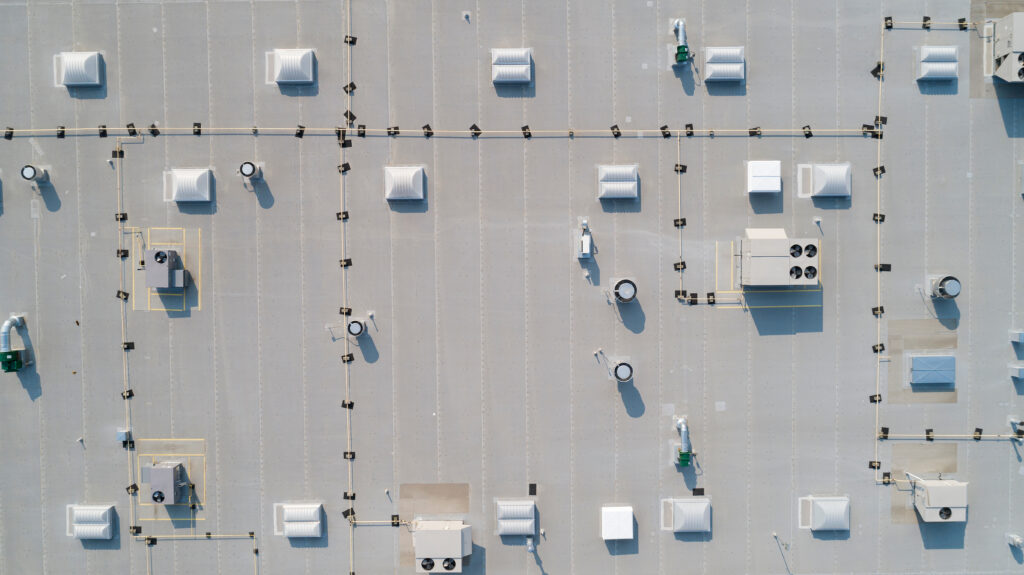
Your commercial roof protects everything underneath it — your inventory, your equipment, your employees, and your bottom line. But unlike a leaky faucet or a broken window, a failing roof doesn’t always announce itself with obvious drama. The damage often starts quietly, and by the time you notice water stains on the ceiling tiles, the underlying problem may have been spreading for months.
The good news is that most commercial roofs give off clear warning signals before they reach the point of failure. Knowing what to look for can save you tens of thousands of dollars in emergency repairs, interior damage, and business disruption. Here are the seven commercial roof replacement signs every property owner and facility manager in Kansas City and Atlanta should watch for.
1. Persistent or Recurring Leaks
An occasional leak after a major storm doesn’t necessarily mean your roof is finished. But when leaks keep coming back — even after your contractor patches them — that’s a different story. Recurring water intrusion usually means the damage has moved beyond the surface membrane into the insulation layer or the roof deck itself. At that point, spot repairs are just temporary bandages on a deeper problem.
Watch for water stains on ceiling tiles, damp spots on interior walls, and musty odors in rooms that sit directly below the roofline. In Kansas City, where spring hailstorms can pummel flat roofs year after year, cumulative storm damage is one of the leading causes of leak cycles that won’t quit. Atlanta’s extended thunderstorm season — running from roughly March through late fall — creates similar compounding stress on commercial roofing membranes.
If you’ve called a roofer for leak repairs more than twice in the past 12 months, it’s time for a professional inspection to assess whether the full system needs replacing.
2. Visible Membrane Damage: Bubbling, Cracking, or Blistering
Your roofing membrane is the primary barrier between your building and the elements. When that membrane starts showing physical distress — bubbles, cracks, blisters, or what roofers call “alligatoring” (a pattern of cracks that resembles reptile skin) — it’s telling you that the material is breaking down.
On TPO and EPDM roofs, which are common on commercial buildings across the Kansas City and Atlanta markets, UV exposure and thermal cycling cause the membrane to lose elasticity over time. Once it becomes brittle, it can no longer expand and contract with temperature swings without cracking. And once cracks form, moisture finds its way in fast.
These issues are often visible during a roof walk, but they’re easy to miss from the ground. That’s one reason regular professional inspections are so valuable — a trained eye catches membrane deterioration long before it turns into a leak.
Not sure what condition your commercial roof is in? American Commercial Roofing offers free roof inspections for commercial and residential properties across Kansas City and Atlanta. Call (800) 674-9535 or schedule online to get a professional assessment.
3. Ponding Water That Won’t Drain
Flat and low-slope commercial roofs are designed to shed water, but they need proper drainage to do it. If you notice standing water on your roof 48 hours or more after the last rainfall, that’s called ponding — and it’s a problem.
Ponding water adds weight that your roof structure may not be designed to handle long-term. It also accelerates membrane deterioration, promotes algae and mold growth, and can eventually find or create openings in the roofing system. Over time, the areas beneath chronic ponding can develop soft spots in the decking, which compromises structural integrity.
Common causes include clogged drains, poor original slope design, or structural settling. While some ponding issues can be addressed with improved drainage or tapered insulation, widespread ponding across multiple areas of the roof often signals that the system as a whole needs to be replaced with one designed for proper water management.
4. Rising Energy Bills Without a Clear Cause
Your commercial roof plays a bigger role in your building’s energy performance than most people realize. A well-functioning roof system — especially one with reflective properties or adequate insulation — keeps conditioned air inside and extreme temperatures outside. When that system starts failing, your HVAC works harder to compensate.
If your energy bills have been creeping up over the past year or two and you can’t attribute the increase to rate changes or usage patterns, your roof may be the culprit. Moisture-saturated insulation loses its R-value (thermal resistance), which means your building loses heating efficiency in winter and cooling efficiency in summer. In Kansas City, where temperatures can swing from single digits in January to triple digits in July, that insulation matters enormously. The same is true in Atlanta, where hot, humid summers put sustained pressure on cooling systems.
A roofing professional can perform a thermal scan or core sample to assess your insulation’s condition. If the insulation is saturated, replacing just the membrane won’t solve the problem — you’ll need a full system replacement.
5. The Roof Has Reached the End of Its Expected Lifespan
Every roofing material has a designed service life, and pushing well past that date is a calculated risk. Here’s a general guide to how long commercial roofing systems typically last with proper maintenance:
TPO membranes: 20 to 30 years. EPDM rubber roofing: 20 to 30 years. Modified bitumen: 15 to 20 years. Built-up roofing (BUR): 20 to 30 years. Metal roofing: 30 to 50+ years. Asphalt shingles (steep-slope): 15 to 25 years.
These ranges assume regular maintenance and inspections. In hail-prone markets like Kansas City and storm-heavy regions like metro Atlanta, severe weather events can shave years off those estimates. If your roof is within five years of the end of its expected lifespan and you’re starting to see any of the other signs on this list, replacement planning should move to the top of your capital expenditure list.
In our experience working with property owners across both markets, proactive replacement before catastrophic failure almost always costs less than emergency replacement after a major weather event or interior flood.
6. Damaged or Deteriorating Flashing and Seams
Flashing — the metal or membrane material that seals transitions around vents, HVAC units, skylights, parapets, and roof edges — is one of the most vulnerable parts of any commercial roof. Seams, where membrane sheets overlap and are bonded together, are another common failure point.
When flashing pulls away from the wall, cracks at the corners, or shows signs of rust and corrosion, it creates direct pathways for water to enter the building. Similarly, when seams begin to separate or lift, they expose the underlayment and decking to moisture. Both issues tend to worsen quickly once they start, especially during storm season.
Isolated flashing repairs are routine maintenance. But when flashing failures are showing up in multiple locations across the roof, or when seam separation is widespread, it usually indicates that the entire roofing system is aging out and a full replacement is the more reliable long-term solution.
Flashing problems and seam failures tend to accelerate during storm season. Don’t wait for the next big storm to find out where your roof is vulnerable. Schedule a free inspection with ACR and get ahead of the damage.
7. Sagging, Soft Spots, or Structural Concerns
This is the sign you absolutely cannot afford to ignore. If any section of your roof deck feels soft or spongy when you walk on it, or if you can see visible sagging from inside the building, the structural integrity of the roofing system has been compromised.
Sagging typically results from prolonged moisture exposure that has weakened the decking material, or from excessive weight loads (like chronic ponding water or accumulated debris). In severe cases, it can indicate that the structural supports themselves need attention, not just the roofing system above them.
Soft spots and structural sagging are not repair situations — they are replacement situations. Continuing to operate under a structurally compromised roof puts your building’s occupants, contents, and your liability exposure at serious risk. If you notice any sag or bounce in your roof deck, call a qualified commercial roofing contractor immediately.
What to Do If You Spot These Warning Signs
If you’ve recognized one or more of these warning signs on your commercial property, the smartest next step is a professional roof inspection. A qualified contractor will assess the membrane condition, check the insulation, evaluate the flashing and drainage, and give you an honest picture of how much useful life your roof has left.
At American Commercial Roofing, we’ve been doing exactly that for property owners across Kansas City and Atlanta. We’re a family-owned company with manufacturer certifications across TPO, EPDM, metal, and modified bitumen systems, and we back our work with comprehensive warranty programs. We’ll tell you straight whether your roof needs a targeted repair or a full replacement — and if it’s time for a new roof, we’ll walk you through every step of the process from material selection to final inspection.
Schedule Your Free Roof Inspection
Catching problems early saves thousands. Let our certified team inspect your commercial roof and give you a clear, honest assessment — completely free.